From chat to work: why many AI agent projects fail
Gartner expects over 40% of agentic AI projects to be cancelled by 2027. What the successful organizations do differently, and what it means in industry.
These days it is hard to find software that does not claim to have agents. Gartner predicts that up to 40% of enterprise applications will include task-specific agents by the end of 2026, up from less than 5% in 2025. The same firm predicts that over 40% of agentic AI projects will be cancelled by the end of 2027, because of rising costs, unclear business value or inadequate risk controls. Both predictions are right, and the difference lies in how agents are built.
A chatbot was not enough
An agent is a system that does more than answer: it plans the steps of a task, uses software and data, and carries the task out. The need for it came from a disappointment. In June 2025 McKinsey called it the gen AI paradox: nearly eight in ten companies use generative AI, and just as many report no significant impact on their bottom line; about 90% of function-specific use cases remain stuck in pilot mode.
The reason is simple. An assistant that answers questions saves each person a little time, but it does not change the process itself. In April 2026 Gartner predicted that by 2028 more than half of enterprises will stop paying for assistive AI and turn to platforms that deliver the result of a workflow.
Real agents and agents in name
Gartner warns of agent washing: chatbots and older automation tools rebranded as agents. It estimates that of the thousands of vendors talking about agents, only about 130 build real ones. On Gartner's 2026 Hype Cycle, agentic AI sits at the Peak of Inflated Expectations: only 17% of organizations have deployed agents, and in Gartner's words, fully autonomous agents are not ready for the majority of enterprise use cases.
What successful organizations do
The evidence of the last few years on what separates successful projects is clearer than ever:
- They start from the process, not the model. In McKinsey's 2025 survey, the organizations getting the most from AI (about 6% of respondents) were nearly three times as likely as others to have fundamentally redesigned their workflows, one of the strongest contributors to results that McKinsey tested.
- They keep a person at the point of decision. In Capgemini's 2025 research, executives' trust in fully autonomous agents fell from 43% to 27% in a year, and 90% saw human involvement as positive or cost-neutral.
- They design governance and access from the start. Deloitte reported in 2026 that only 21% of organizations have a mature governance model for agents, meaning it is often unclear what an agent can reach and what it has done.
- They connect through standards. The Model Context Protocol (MCP), introduced in November 2024, is now the common standard for connecting models to tools and data, and since December 2025 it has been governed under the Linux Foundation. The standard itself says a person should always be able to deny a tool call.
- They stay the owners of their system. Today, 29 September 2026, Gartner predicted that by 2028, 70% of enterprises will abandon agentic AI built for them by vendors' engineers, because costs climb and they cannot evolve it themselves. Gartner's advice: plan knowledge transfer and ownership from day one.
Taken together, the evidence says an agent is an engineering problem first: the right connections to data and software, clear rules of access, points where a person approves, and a system the organization can maintain itself. That is why McKinsey's 2026 survey finds 40% of large organizations scaling agents, up from 27% a year earlier; those who built the foundations have pulled ahead.
What an agent means in a plant
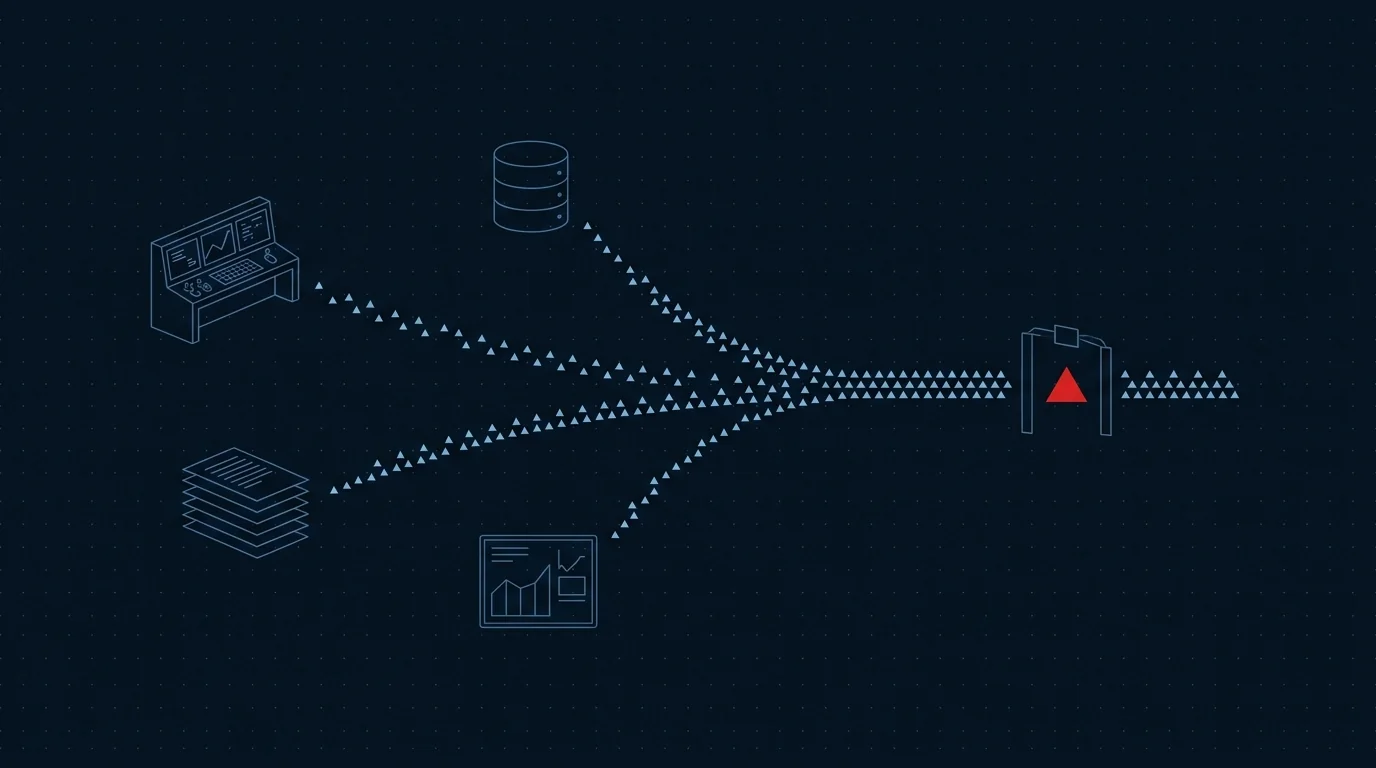
In industry, an agent is valuable when it turns several separate systems into one workflow. A simple example:
- Live data is read from the distributed control system (DCS) and the historian.
- A prediction model detects that product quality is drifting off spec before the lab result arrives.
- An agent searches the operating procedures and similar past cases, and drafts a setpoint recommendation with its sources.
- The operator sees the recommendation and approves or rejects it; the agent never commands the control system itself.
- The result and the decision are recorded in the shift report.
None of these steps is new on its own. What is new is connecting them, in an environment where data never leaves the plant and every step can be traced.
Vakav's view
The VAI platform was built for this kind of work. It is installed on a server in the plant, connects directly to the control system, databases and files, and provides a scripting environment, a visual workflow editor, scheduling and event triggers, so that model results reach the control-room screen as recommendations. Vakav Autonomous brings the same logic to the organization's knowledge: bots, skills and a flow builder for agents that work on the organization's own documents and software, all on its own servers. And because the infrastructure is yours, the system stays with you and grows with you.
If you have a process you want to turn into an intelligent workflow, read about VAI or talk to us.