A quarter of the world's DRI, and quality known hours late
Iran is the world's second-largest DRI producer, yet product quality is known only hours later in the lab. How a soft sensor closes the gap.
According to Midrex's annual statistics, published in September 2026, world production of direct-reduced iron (DRI, or sponge iron) reached a record 151.0 million tonnes in 2025, and Iran, with 37.2 million tonnes, was the second-largest producer after India: about a quarter of world output. All of Iran's DRI is made with natural gas, about 90% of it with the MIDREX process. (Midrex estimates Iran's figures from worldsteel data.)
Few countries gain as much as Iran from every percent of improvement in this process. And one of the largest opportunities lies in the gap between making the product and knowing its quality.
Quality is known hours later
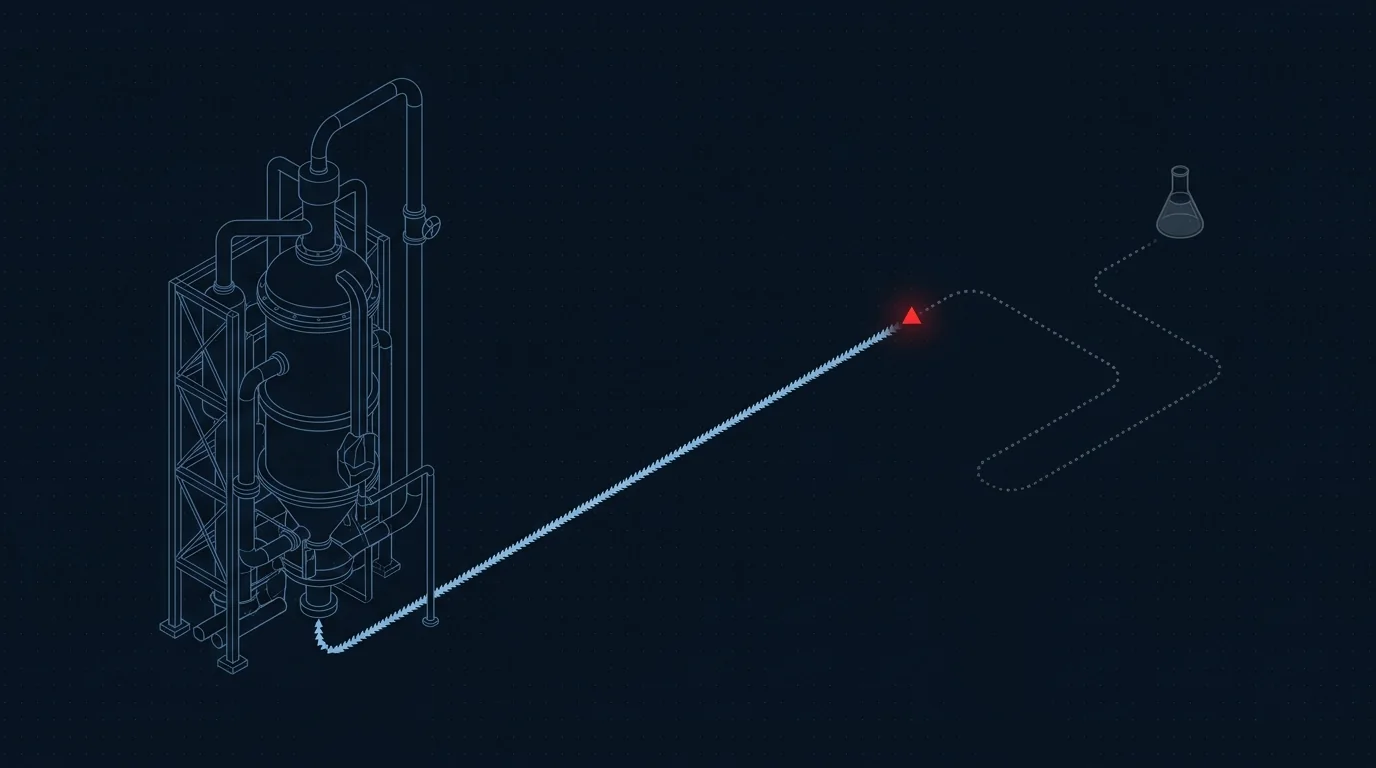
The two main quality measures of DRI, metallization and carbon content, are usually measured by sampling and lab analysis. A Siemens patent granted in 2009 gives lab delays of 5 to 9 hours for metallization and 3.5 to 7.5 hours for carbon. Meanwhile the furnace keeps running, and operators steer it by experience and with a safety margin.
That margin has a cost. When quality is known late, either off-spec product is made, or the furnace is deliberately run with a wider margin, which means more gas and energy. In years when the steel industry faces gas and power constraints, the margin gets more expensive: according to the head of the Iranian Steel Producers Association, power cuts cost the industry about USD 14.1 billion between March 2021 and March 2025.
What a soft sensor is
A soft sensor is a model that estimates a quantity that is hard or slow to measure from quantities that are already measured. In a direct-reduction furnace, those are temperatures, pressures, reducing-gas flow and composition, feed rate and dozens of other signals the control system records every second. The model learns from past data how these signals relate to the lab results, and from then on predicts quality in real time. The method has more than two decades of history in the process industries, and scientific reviews treat it as a cheaper alternative or complement to hardware analyzers.
The evidence: less variation, more output
- In DRIpax, the system Midrex and Primetals built for MIDREX plants, predicting metallization and carbon at Qatar Steel's Module II reduced the standard deviation of carbon by 31% and of metallization by 27% (vendor report, 2016).
- The Siemens patent reports standard-deviation reductions of about 40% for metallization and 30% for carbon, with about 1% more production.
- In the World Economic Forum's Global Lighthouse Network, which recognizes the most advanced factories, Tata Steel's AI model for predicting and controlling hot-metal silicon cut quality variability by 33% (2019). In January 2026, SOCAR's urea plant used machine-learning closed-loop control to raise throughput by 21% and gas efficiency by 24%.
- In Rockwell Automation's 2025 survey, quality control was the most common use of AI in manufacturing.
Less variation matters more than it sounds. When quality varies less, the process target can move closer to the specification limit: the same product with less gas, or more output, without raising the risk of going off spec.
What it takes
- Control-system data from the distributed control system (DCS) or the historian, over a long enough period.
- Lab data aligned in time with the process data, because today's sample reflects the furnace several hours earlier.
- Cleaning and signal selection: removing outliers, smoothing, and finding the signals that really drive quality.
- Running beside the operator: the prediction must reach the control-room screen at once, not a report read the next day.
- Model maintenance: furnaces, raw materials and operating conditions change, and the model has to keep up.
Vakav's view
We built DRI Expert for exactly this gap: a module on the VAI platform for MIDREX direct reduction. It predicts the metallization, carbon and sulfur of the product online, before the lab result, and recommends ranges for temperature, pressure, reducing-gas ratio and feed rate to reach the target quality with less gas. The data comes from the plant's own control system and never leaves the plant. And because AryaVakav builds control systems, connecting to the control room is familiar ground for us.
If you work in a direct-reduction plant, see the DRI Expert page or contact us about a pilot.