
Online vs Offline AI Models
In this comprehensive article, we explore the differences, benefits, and use cases of online (cloud-based) and offline (on-premise) AI models to help organizations make the right choice.
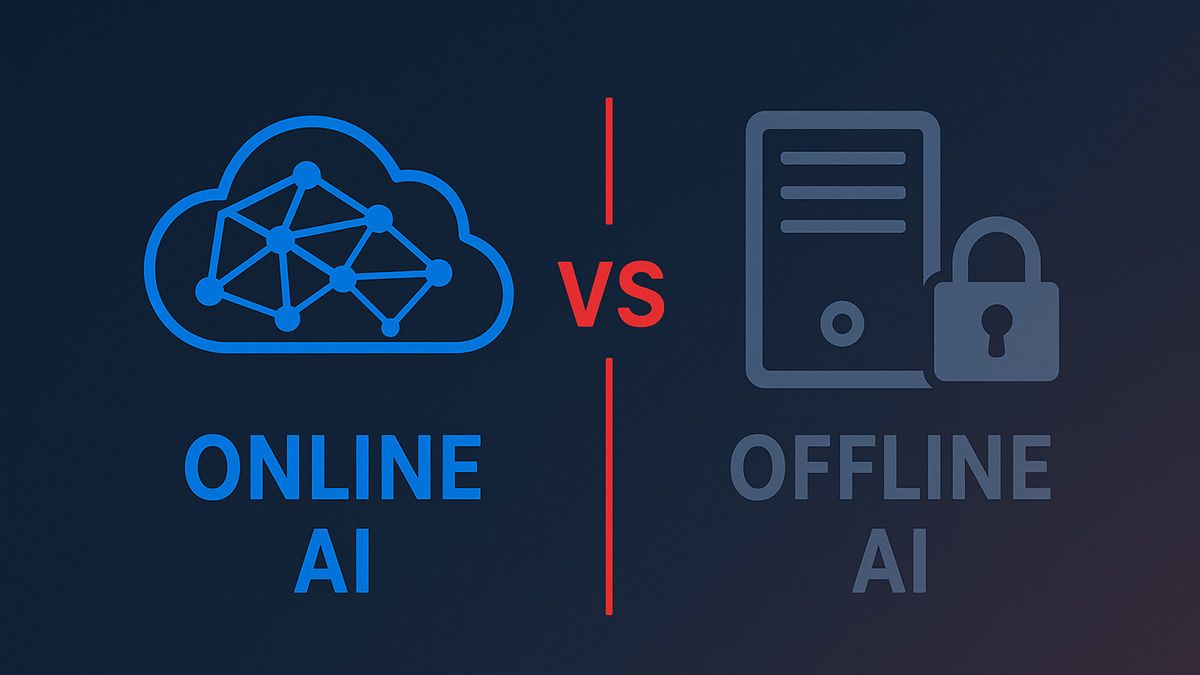
As Artificial Intelligence evolves, organizations increasingly rely on Large Language Models (LLMs) for search, summarization, Q&A, and content generation. One of the most important decisions is choosing between online (cloud-based) and offline (on-premise) models.
Each approach has unique strengths and trade-offs. Understanding these differences helps organizations optimize for security, scalability, cost, and customization.
Online LLMs
Cloud-based LLMs are hosted by providers such as OpenAI, Anthropic, Google Gemini, HuggingFace, AWS Bedrock, and more.
Advantages
- Always updated to the latest version
- High scalability and reliability
- No need for local hardware investment
- Professional maintenance and support
- Limitations
- Data privacy and compliance concerns
- Ongoing subscription and usage costs
- Requires stable internet connectivity
- Best Use Cases
- Large-scale projects with fluctuating workloads
- Organizations seeking cutting-edge AI models
- Scenarios where data sensitivity is moderate
- Offline LLMs
Offline or on-premise LLMs run locally on organizational hardware. Examples include Ollama, LM Studio, LocalAI, KoboldCPP, Oobabooga.
Advantages
- Complete control over data and privacy
- No dependency on internet access
- One-time hardware investment instead of recurring fees
- Deep customization for organizational needs
- Limitations
- Requires powerful infrastructure (GPU, RAM)
- Manual updates and maintenance
- Less scalable compared to the cloud
- Best Use Cases
- Government and research organizations prioritizing data confidentiality
- Environments with limited or no internet access
- Projects demanding full customization
Conclusion
The choice between online and offline models depends on your organizational priorities. Online models deliver scalability and cutting-edge innovation, while offline models ensure security and control.
For many organizations, the ideal solution is to combine both approaches to achieve maximum flexibility.